


Clinical Bottom Line
The jawbone under a complete denture keeps shrinking for as long as the denture is worn, and the lower denture is usually the one that becomes loose. Randomized trials and systematic reviews consistently show that a lower denture held by two implants gives better satisfaction, comfort, stability, chewing and bite force than a new conventional denture. The same evidence is more cautious than most marketing: the size of the benefit varies, the effect on general quality of life is uncertain, and nutrition does not improve by itself. A conventional denture remains a reasonable treatment, and a two-implant overdenture is best understood as a well-supported minimum standard for the lower jaw, not as the only acceptable option.
Why a Lower Denture Is Harder to Wear Than an Upper
A conventional complete denture rests on the gums and the bone underneath them. An upper denture covers the palate, which gives it a broad surface and a seal. A lower denture sits on a narrow, horseshoe-shaped ridge, next to a tongue and cheeks that move every time a person speaks or swallows. It depends far more on the shape of the ridge to stay in place.
The ridge keeps changing
That ridge is not permanent. Tallgren (1972) followed complete denture wearers for 25 years and documented a continuing reduction of the residual ridges across the whole period. As the ridge flattens, the denture has less to hold on to, which is why a denture that fit well when it was made can loosen years later even though the denture itself has not changed.
Clinical takeaway
Residual ridge resorption continues throughout denture wear; lower-denture instability is an anatomical problem, not only a fit problem.
Patient takeaway
A loose lower denture is usually caused by the jawbone shrinking, not by something you did wrong.
Do Implants Slow the Bone Loss Under a Denture?
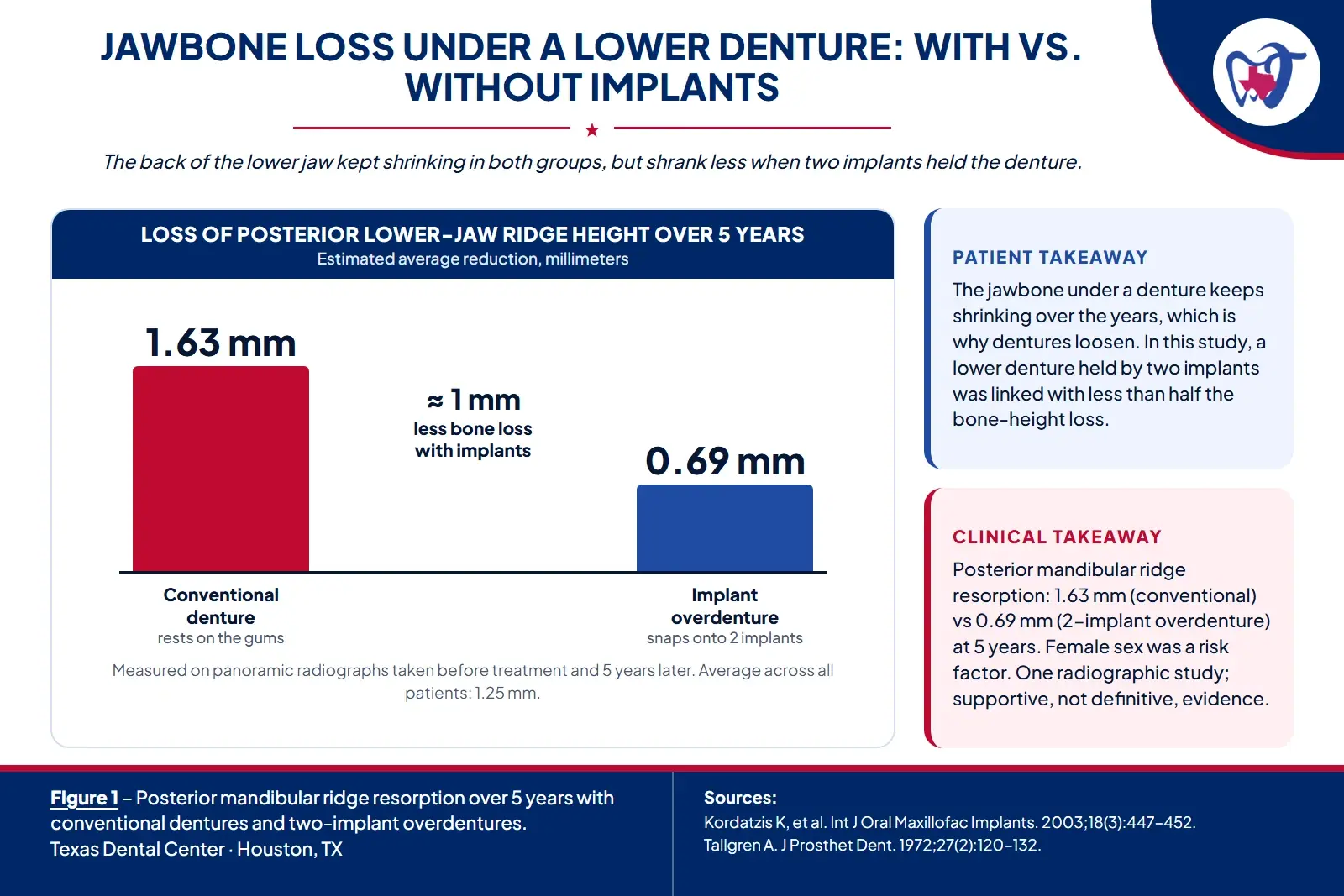
Kordatzis et al. (2003) measured the back of the lower jaw on panoramic radiographs taken before treatment and again 5 years later, in patients wearing either conventional dentures or overdentures supported by two implants. The estimated average loss of ridge height was 1.25 mm over 5 years: 1.63 mm in the conventional denture groups and 0.69 mm in the implant overdenture groups, a difference of almost 1 mm.
How to read this result
Bone loss continued in both groups, so implants at the front of the jaw did not stop resorption at the back. Female sex was a risk factor for greater resorption, while the number of years without teeth, the starting height of the jaw and the number of dentures previously worn showed no association. This was a single radiographic study, so it supports the idea that implants help protect the ridge without proving it conclusively.
Clinical takeaway
Posterior mandibular resorption at 5 years: 1.63 mm with conventional dentures vs 0.69 mm with two-implant overdentures. Supportive, single-study evidence.
Patient takeaway
In one 5-year study, people whose lower denture was held by two implants lost less than half as much jawbone height.
Chewing, Bite Force and Nutrition: What Actually Improves
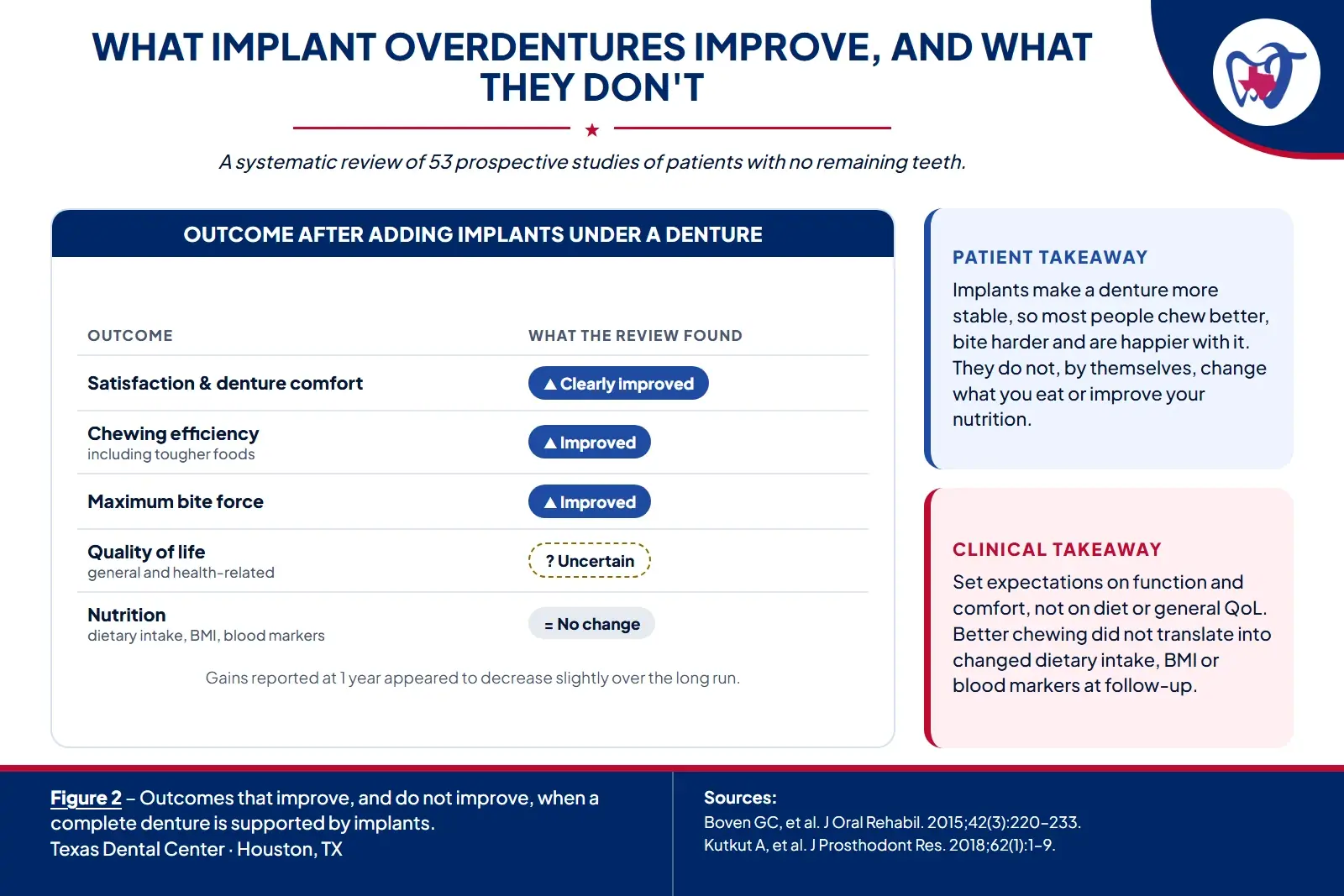
Boven et al. (2015) systematically reviewed 53 prospective studies of patients with no remaining teeth who received implants to support a denture, each with an assessment before treatment and at least 1 year after. Chewing efficiency improved, maximum bite force increased and patients could eat tougher foods. Satisfaction with denture comfort was clearly higher.
What did not change
The same review found no change in dietary intake, body mass index or blood markers, and the effect on general quality of life was uncertain. The improvements reported after 1 year also appeared to decrease slightly over the long term. Being able to chew better is not the same as eating better; a patient who has avoided certain foods for years does not automatically return to them.
Clinical takeaway
Counsel on function and comfort. Improved masticatory performance did not translate into changed dietary intake, BMI or blood markers.
Patient takeaway
Implants help most people chew better and bite harder. They do not, on their own, change what you eat or improve your nutrition.
What the Randomized Trials Show About Satisfaction
Awad et al. (2003) randomly assigned 60 patients aged 65 to 75 to a new conventional lower denture or a lower overdenture on two implants, each opposing a conventional upper denture. Two months after delivery, the implant group reported significantly better general satisfaction, comfort, stability and ability to chew, and fewer oral health-related quality of life problems.
Pooling the trials
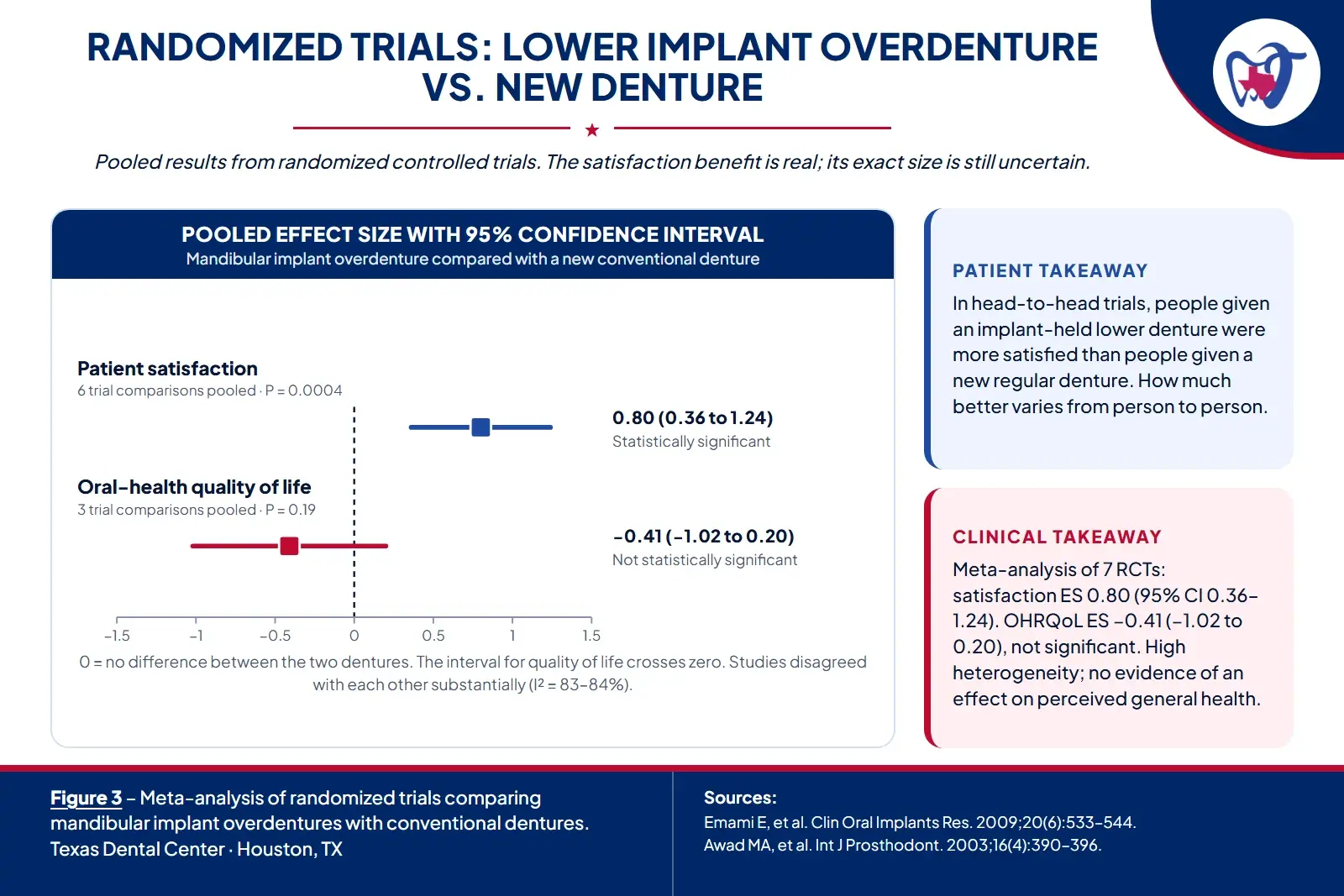
Emami et al. (2009) combined the randomized trials available at the time. Implant overdentures were rated more satisfactory at a clinically relevant level (pooled effect size 0.80, 95% confidence interval 0.36 to 1.24). The pooled result for oral health-related quality of life did not reach statistical significance (effect size −0.41, 95% confidence interval −1.02 to 0.20), the trials disagreed substantially with one another, and there was no evidence of an effect on perceived general health. The authors concluded that overdentures may be more satisfying but that the magnitude of the effect is still uncertain.
Clinical takeaway
RCT evidence supports higher satisfaction with mandibular implant overdentures; heterogeneity is high (I² about 84%) and the OHRQoL pooled estimate crosses zero.
Patient takeaway
In head-to-head studies, people with an implant-held lower denture were more satisfied. How much better it feels varies from person to person.
Who Benefits Most, and What the Consensus Statements Say
Kutkut et al. (2018) reviewed 26 comparative studies and found that lower overdentures on two unsplinted implants were associated with better chewing performance, quality of life, comfort, stability and speech than conventional dentures. An umbrella review of eight systematic reviews (Sharka et al., 2019) reached the same overall conclusion with an important qualifier: the benefit is most pronounced in patients who ask for implant treatment or who cannot adapt to conventional dentures, and both cost and a person's ability to adapt affect how well either treatment is tolerated.
McGill and York
The McGill consensus statement (Feine et al., 2002) proposed the two-implant overdenture as the first-choice standard of care for the lower jaw without teeth, and the York consensus statement reaffirmed it in 2009. In their review of the supporting literature, Thomason et al. (2012) describe the two-implant overdenture as a minimum standard that should be sufficient for most people, taking into account performance, satisfaction, cost and clinical time, and state plainly that it is not the gold standard of implant therapy.
Clinical takeaway
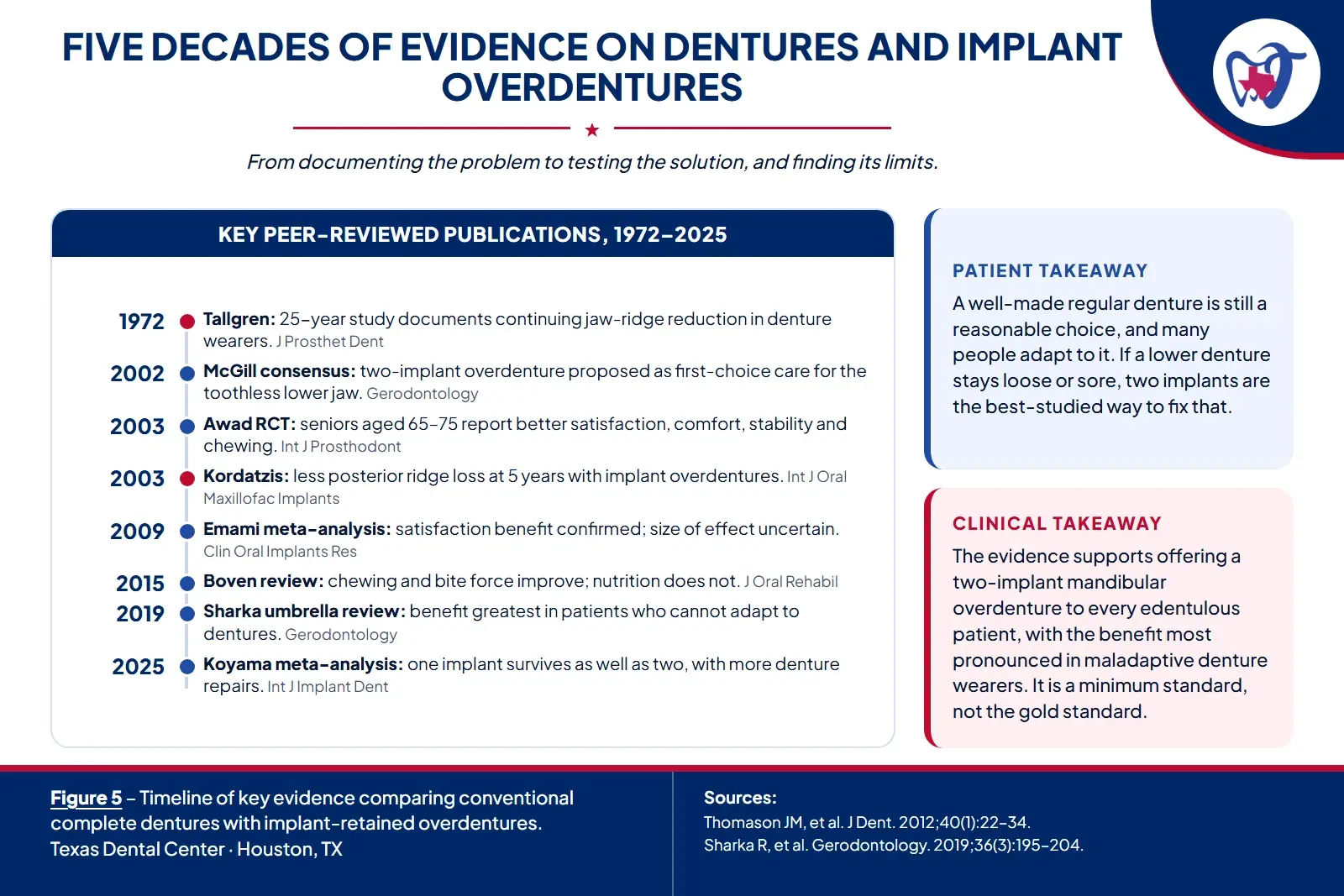
Offer the two-implant mandibular overdenture as an option to every edentulous patient; expect the largest gain in maladaptive denture wearers.
Patient takeaway
If you get along well with your denture, you may not need implants. If your lower denture stays loose or sore, two implants are the best-studied solution.
One Implant or Two?
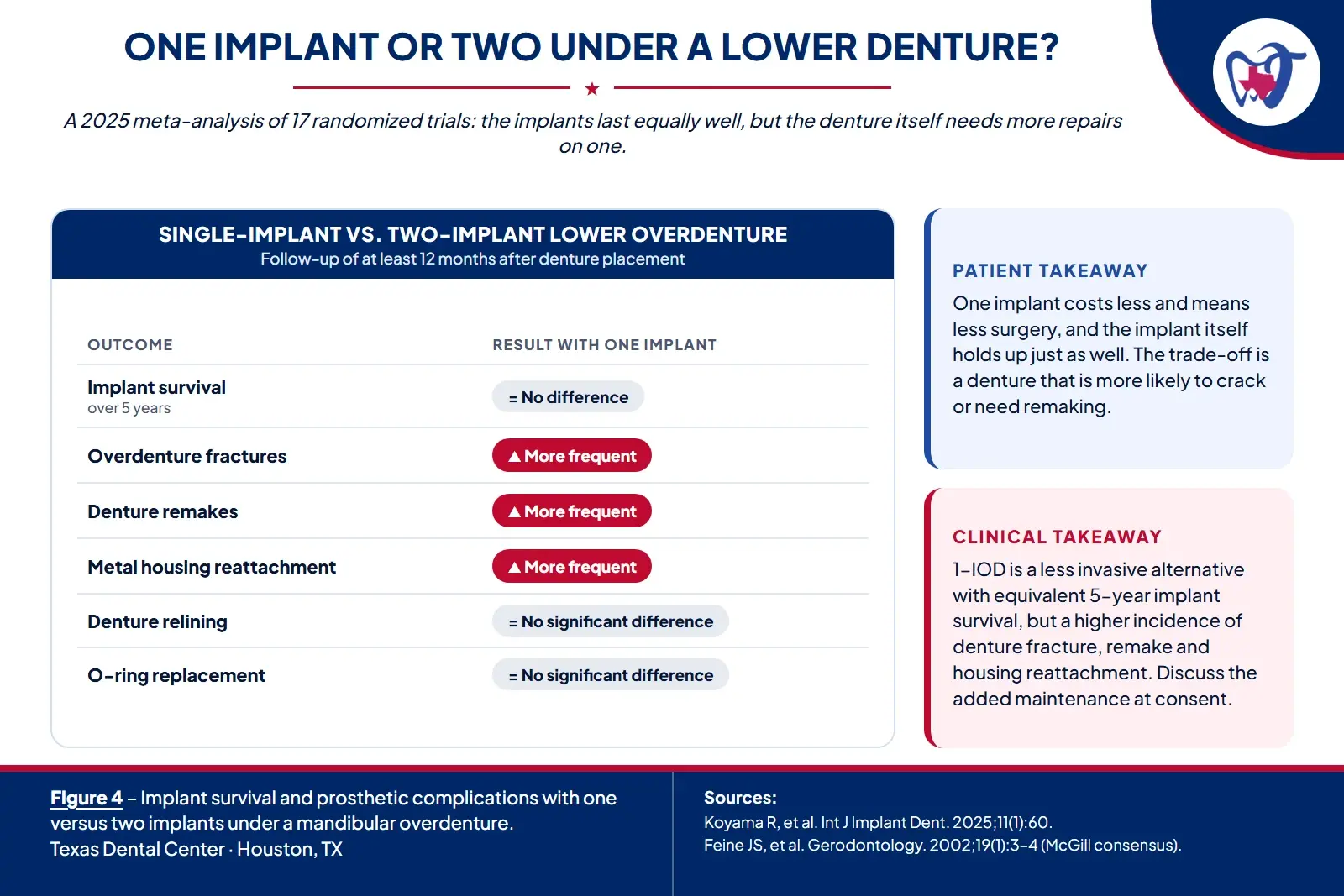
A single implant in the middle of the lower jaw costs less and involves less surgery, so it is a reasonable question. Koyama et al. (2025) pooled 17 randomized controlled trials comparing one-implant and two-implant lower overdentures, each with at least 12 months of follow-up after the denture was placed.
Same implant survival, more denture repairs
Implant survival did not differ between the two groups over a 5-year period. The differences were in the denture: fractures, remakes and reattachment of the metal housing were more frequent with one implant, while the need for relining and O-ring replacement did not differ significantly. The authors conclude that a single implant may be a less invasive alternative, but that the higher rate of prosthetic complications deserves careful consideration.
Clinical takeaway
1-IOD and 2-IOD show equivalent 5-year implant survival; 1-IOD carries more denture fractures, remakes and housing reattachments.
Patient takeaway
One implant holds up just as well as two, but the denture on top is more likely to crack or need to be remade.
What the Evidence Does Not Tell Us
Most of this research concerns the lower jaw. Of the 26 studies reviewed by Kutkut et al. (2018), only one compared an upper conventional denture with an upper implant overdenture, so the conclusions above should not be assumed to apply to the upper jaw. Follow-up in many studies is short: most of those reviewed by Boven et al. (2015) reported results at 1 year.
Cost and individual factors
Emami et al. (2009) specifically called for more cost-effectiveness research, and Sharka et al. (2019) note that financial factors affect how patients experience either treatment. Implants also require surgery, healing time, sufficient bone and long-term maintenance of the attachments. None of the studies can say which option is right for one particular person; that depends on anatomy, health, expectations and budget.
Clinical takeaway
Evidence is strongest for the mandible and for short-to-medium follow-up; maxillary overdenture and cost-effectiveness data are limited.
Patient takeaway
The research is strongest for the lower jaw. Whether implants are worth it for you depends on your mouth, your health and your budget.
Texas Dental Center: Clinical Perspective
Patients who ask us about implants for a denture are usually dealing with a lower denture that moves when they eat or speak. The literature explains why that complaint is so common, and it also explains why we do not present implants as the answer for everyone: many people function well with a carefully made conventional denture.
Our role is to explain what the evidence does and does not show, examine the bone that is available, and let the patient weigh comfort, surgery, maintenance and cost. The most important step is informed planning, not pressure.
Summary: What Patients and Clinicians Should Understand
- The jawbone under a denture continues to shrink for as long as the denture is worn.
- The lower denture is usually the one that becomes loose.
- In one 5-year study, a two-implant overdenture was linked with less than half the bone-height loss.
- Implant overdentures improve satisfaction, comfort, chewing and bite force.
- Nutrition does not improve by itself, and the effect on general quality of life is uncertain.
- The benefit is greatest for people who cannot adapt to a conventional denture.
- One implant survives as well as two, but the denture needs more repairs.
- Most of the evidence concerns the lower jaw.
Frequently Asked Questions
What is an implant overdenture?
Why does my lower denture feel looser than my upper?
Do implants stop the jawbone from shrinking?
Will I be able to eat anything with an implant overdenture?
Is one implant enough to hold a lower denture?
Is a regular denture still a good option?
Does this research apply to upper dentures too?
References
- Awad MA, Lund JP, Shapiro SH, et al. Oral health status and treatment satisfaction with mandibular implant overdentures and conventional dentures: A randomized clinical trial in a senior population. The International Journal of Prosthodontics. 2003;16(4):390-396. PubMed (opens in a new tab)
- Boven GC, Raghoebar GM, Vissink A, Meijer HJ. Improving masticatory performance, bite force, nutritional state and patient's satisfaction with implant overdentures: A systematic review of the literature. Journal of Oral Rehabilitation. 2015;42(3):220-233. PubMed (opens in a new tab)
- Emami E, Heydecke G, Rompré PH, de Grandmont P, Feine JS. Impact of implant support for mandibular dentures on satisfaction, oral and general health-related quality of life: A meta-analysis of randomized-controlled trials. Clinical Oral Implants Research. 2009;20(6):533-544. PubMed (opens in a new tab)
- Feine JS, Carlsson GE, Awad MA, et al. The McGill consensus statement on overdentures. Mandibular two-implant overdentures as first choice standard of care for edentulous patients. Gerodontology. 2002;19(1):3-4. PubMed (opens in a new tab)
- Kordatzis K, Wright PS, Meijer HJ. Posterior mandibular residual ridge resorption in patients with conventional dentures and implant overdentures. The International Journal of Oral & Maxillofacial Implants. 2003;18(3):447-452. PubMed (opens in a new tab)
- Koyama R, Shiratsuchi H, Hasuike A, et al. Single versus two implant-supported mandibular overdentures: A systematic review and meta-analysis of implant survival and prosthetic complications. International Journal of Implant Dentistry. 2025;11(1):60. PubMed (opens in a new tab)
- Kutkut A, Bertoli E, Frazer R, et al. A systematic review of studies comparing conventional complete denture and implant retained overdenture. Journal of Prosthodontic Research. 2018;62(1):1-9. PubMed (opens in a new tab)
- Sharka R, Abed H, Hector M. Oral health-related quality of life and satisfaction of edentulous patients using conventional complete dentures and implant-retained overdentures: An umbrella systematic review. Gerodontology. 2019;36(3):195-204. PubMed (opens in a new tab)
- Tallgren A. The continuing reduction of the residual alveolar ridges in complete denture wearers: A mixed-longitudinal study covering 25 years. The Journal of Prosthetic Dentistry. 1972;27(2):120-132. PubMed (opens in a new tab)
- Thomason JM, Feine J, Exley C, et al. Mandibular two implant-supported overdentures as the first choice standard of care for edentulous patients: The York Consensus Statement. British Dental Journal. 2009;207(4):185-186. PubMed (opens in a new tab)
- Thomason JM, Kelly SA, Bendkowski A, Ellis JS. Two implant retained overdentures: A review of the literature supporting the McGill and York consensus statements. Journal of Dentistry. 2012;40(1):22-34. PubMed (opens in a new tab)
Wearing a denture that will not stay in place? Learn more about our denture services and the implant options that can stabilize them.
