
Clinical Bottom Line
Post-extraction alveolar bone remodeling is a predictable, biologically driven process that results in measurable loss of ridge width and height. High-quality systematic reviews consistently demonstrate that the majority of dimensional changes occur early, particularly within the first 3–6 months following extraction. Alveolar ridge preservation techniques can reduce the magnitude of bone loss but do not eliminate physiologic remodeling. Early planning plays a critical role in preserving bone volume and maintaining future treatment options—especially when implant therapy may be considered.
Understanding the Functional Nature of Alveolar Bone
Alveolar bone is a specialized, tooth-dependent structure whose primary function is to support the dentition. Unlike basal bone, its volume and architecture are maintained through functional loading transmitted via the periodontal ligament.
Physiologic remodeling after extraction
When a tooth is removed, this biologic stimulus is eliminated. The body responds through a coordinated remodeling process involving osteoclastic resorption and bone reorganization. This process is physiologic, not pathologic, and has been well documented in clinical and radiographic studies (Schropp et al., 2003). Bone resorption is not a complication—it is the expected outcome of normal healing in the absence of a tooth.
Clinical takeaway
Alveolar bone is function-dependent. Removal of the tooth initiates remodeling and resorption.
Patient takeaway
The bone around a tooth exists because the tooth is there. Once removed, the bone naturally begins to shrink.
Post-Extraction Dimensional Changes: What the Evidence Shows
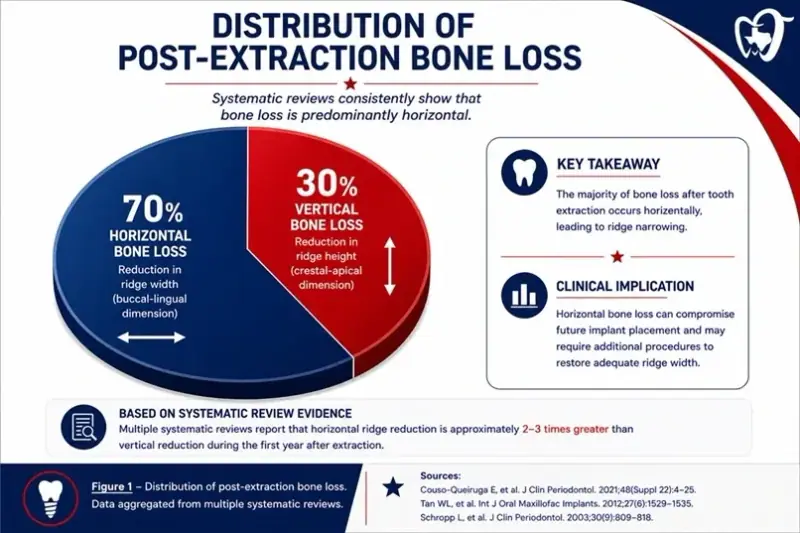
Building on this biologic framework, numerous systematic reviews have quantified the extent and pattern of post-extraction bone loss. Tan et al. (2012) demonstrated that ridge width may decrease by up to 50% within the first year, with the majority of this loss occurring within the first few months. Couso-Queiruga et al. (2021) confirmed these findings in a comprehensive meta-analysis of unassisted socket healing.
Horizontal versus vertical loss
A critical observation across studies is that bone loss is not uniform: horizontal bone loss (ridge width) is significantly greater, while vertical bone loss (ridge height) is less pronounced but still clinically relevant. This distinction matters because implant placement requires sufficient bone in three dimensions. A ridge may appear acceptable clinically, but inadequate width can compromise implant positioning.
Clinical takeaway
Post-extraction bone loss is predictable and predominantly horizontal.
Patient takeaway
After a tooth is removed, the jawbone usually becomes narrower—even if it still looks normal.
Why Bone Loss Matters for Future Implant Therapy
What implants require
Dental implants require adequate bone volume for proper positioning, primary stability, and long-term success. As post-extraction remodeling progresses, bone volume decreases, implant placement becomes more difficult, and additional procedures (for example, grafting) may be required.
Clinically, a case that could have been treated with a straightforward implant shortly after extraction may become significantly more complex months or years later. While many advanced cases can still be treated successfully, they often require additional surgical steps, longer healing times, and increased cost.
Clinical takeaway
Bone loss can convert a simple implant case into a complex reconstructive case.
Patient takeaway
If too much bone is lost, implants may still be possible—but extra procedures may be needed first.
Posterior Maxilla: Why Upper Back Teeth Require Special Attention
Although bone loss occurs throughout the mouth, the posterior maxilla presents unique challenges due to its proximity to the maxillary sinus. Following extraction of upper premolars and molars, bone height may decrease due to crestal bone resorption and sinus pneumatization (downward expansion of the sinus).
Ridge preservation and sinus augmentation risk
Mahardawi et al. (2025) demonstrated that ridge preservation can reduce sinus expansion and decrease the likelihood of requiring sinus augmentation during implant placement. Delayed treatment increases the likelihood of needing a sinus lift; early intervention may help preserve vertical bone height.
Clinical takeaway
Bone loss in the upper back jaw is compounded by sinus expansion.
Patient takeaway
Waiting too long after losing an upper back tooth may increase the chance of needing a sinus lift.
Does Ridge Preservation Reduce Bone Loss?
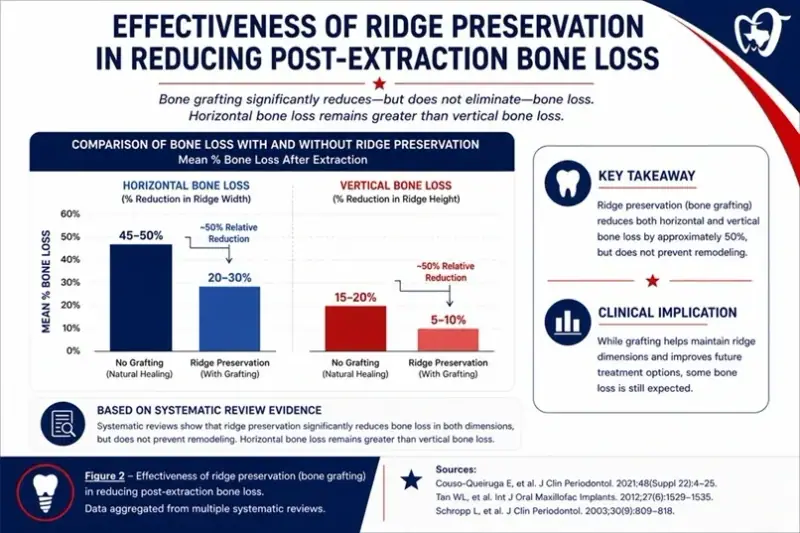
Alveolar ridge preservation (often called bone grafting after extraction) is designed to reduce dimensional changes during healing. High-quality evidence supports its effectiveness, including Ávila-Ortiz et al. (2019), MacBeth et al. (2017), and López-Valverde et al. (2024) across modern techniques.
Setting accurate expectations
It is essential to communicate this accurately: ridge preservation reduces bone loss—but does not eliminate it. Outcomes vary depending on anatomy, infection status, technique, and materials used.
Clinical takeaway
Ridge preservation reduces—but does not prevent—bone remodeling.
Patient takeaway
A bone graft helps keep more bone, but some shrinkage still occurs.
Immediate Implant Placement vs. Delayed Intervention
Immediate implant placement is often considered as a strategy to preserve bone by placing the implant at the time of extraction. While effective in selected cases, evidence shows it does not eliminate bone remodeling, particularly facial bone loss, and outcomes depend heavily on case selection.
Planning over timing alone
Yu et al. (2022) demonstrated high success rates for both immediate and delayed protocols, emphasizing that treatment success depends more on proper planning than timing alone.
Clinical takeaway
Immediate implants are not a universal solution and do not stop bone loss.
Patient takeaway
Same-day implants can work—but only in the right situations.
When Early Intervention Becomes Clinically Significant
Not every extraction requires ridge preservation. The key question is whether preserving bone will affect future treatment options. Early intervention is particularly important when implants are likely, the esthetic zone is involved, bone is thin, multiple teeth are removed, or the posterior maxilla is involved.
Cost and complexity
Cost is often a limiting factor and should be discussed transparently. Avoiding early grafting may increase long-term complexity and cost.
Clinical takeaway
Early intervention is most valuable when it preserves future treatment options.
Patient takeaway
Planning early can make future treatment easier and more predictable.
Delayed Treatment and Increased Complexity Over Time
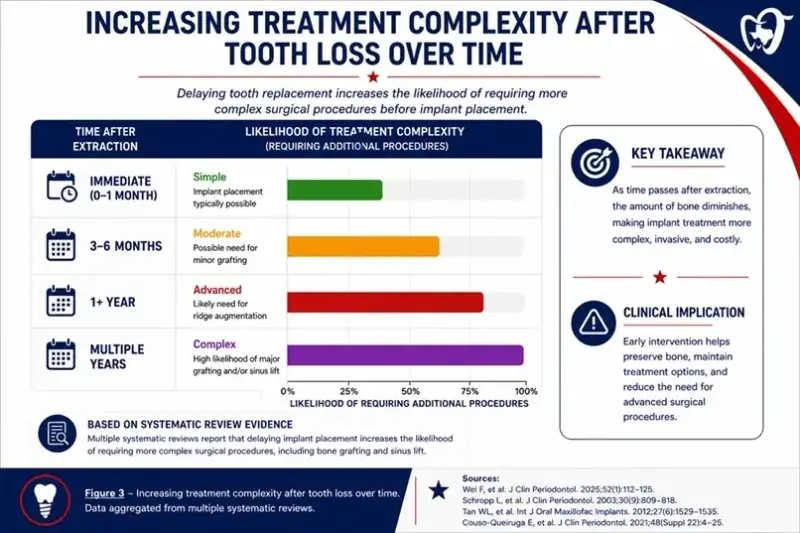
Patients presenting years after extraction often exhibit narrow ridges, reduced bone height, and sinus expansion in the posterior maxilla. Treatment may require guided bone regeneration, ridge augmentation, or sinus lift procedures. While these are predictable procedures, they are more complex than early preservation.
Clinical takeaway
Delayed treatment increases the likelihood of advanced surgical procedures.
Patient takeaway
Waiting too long can make implant treatment more complicated later.
Texas Dental Center: Clinical Perspective
In clinical practice, many patients present months or years after tooth loss expecting straightforward implant placement. In many of these cases, bone volume has already been reduced and additional procedures are required before implants can be placed. This pattern reflects what the literature consistently demonstrates.
The goal of recommending ridge preservation is not to add unnecessary treatment—it is to preserve bone, maintain options, and reduce future complexity. The most important step is informed planning, not pressure.
Summary: What Patients and Clinicians Should Understand
- Bone loss begins immediately after extraction.
- Most changes occur within the first 3–6 months.
- Horizontal bone loss is greater than vertical loss.
- Ridge preservation reduces—but does not eliminate—bone loss.
- The posterior maxilla is especially vulnerable due to sinus expansion.
- Immediate implants do not prevent all remodeling.
- Early planning helps preserve bone and simplify treatment.
Frequently Asked Questions
Does bone loss always happen after a tooth is removed?
How fast does bone loss happen?
Is bone grafting necessary after every extraction?
Does grafting prevent bone loss completely?
Can I wait years before getting an implant?
Why would I need a sinus lift?
References
- Ávila-Ortiz, G., et al. (2019). Effect of alveolar ridge preservation interventions following tooth extraction: A systematic review and meta-analysis. Journal of Clinical Periodontology, 46(Suppl 21), 195–223. PubMed (opens in a new tab)
- Couso-Queiruga, E., et al. (2021). Post-extraction dimensional changes: A systematic review and meta-analysis. Journal of Clinical Periodontology, 48(1), 126–144. PubMed (opens in a new tab)
- López-Valverde, N., et al. (2024). Changes of the alveolar bone ridge using bone mineral grafts and collagen membranes after tooth extraction: A systematic review and meta-analysis. Bioengineering, 11(6), 565. PubMed (opens in a new tab)
- MacBeth, N., et al. (2017). Hard and soft tissue changes following alveolar ridge preservation: A systematic review. Clinical Oral Implants Research, 28(8), 982–1004. PubMed (opens in a new tab)
- Mahardawi, B., et al. (2025). The clinical benefit of alveolar ridge preservation in the posterior maxilla: A systematic review and meta-analysis. Scientific Reports, 15(1), 23019. PubMed (opens in a new tab)
- Schropp, L., et al. (2003). Bone healing and soft tissue contour changes following single-tooth extraction: A clinical and radiographic 12-month prospective study. The International Journal of Periodontics & Restorative Dentistry, 23(4), 313–323. PubMed (opens in a new tab)
- Tan, W. L., et al. (2012). A systematic review of post-extractional alveolar hard and soft tissue dimensional changes in humans. Clinical Oral Implants Research, 23(Suppl. 5), 1–21. PubMed (opens in a new tab)
- Yu, X., et al. (2022). Effects of post-extraction alveolar ridge preservation versus immediate implant placement: A systematic review and meta-analysis. Journal of Evidence-Based Dental Practice, 22(3), 101734. PubMed (opens in a new tab)
Considering implants or grafting after an extraction? Explore our dental implants services for candidacy and treatment sequencing.
