


Clinical Bottom Line
Dental emergencies are among the most common reasons patients seek urgent healthcare. Scientific evidence consistently demonstrates that definitive dental treatment—not antibiotics alone—is the most effective approach for managing most emergency dental conditions. While medications may provide temporary relief, untreated dental infections, traumatic injuries, and severe tooth pain can progress into more serious conditions requiring complex treatment. Modern evidence-based dentistry emphasizes early diagnosis, prompt intervention, and preservation of oral structures whenever possible.
Understanding What Constitutes a True Dental Emergency
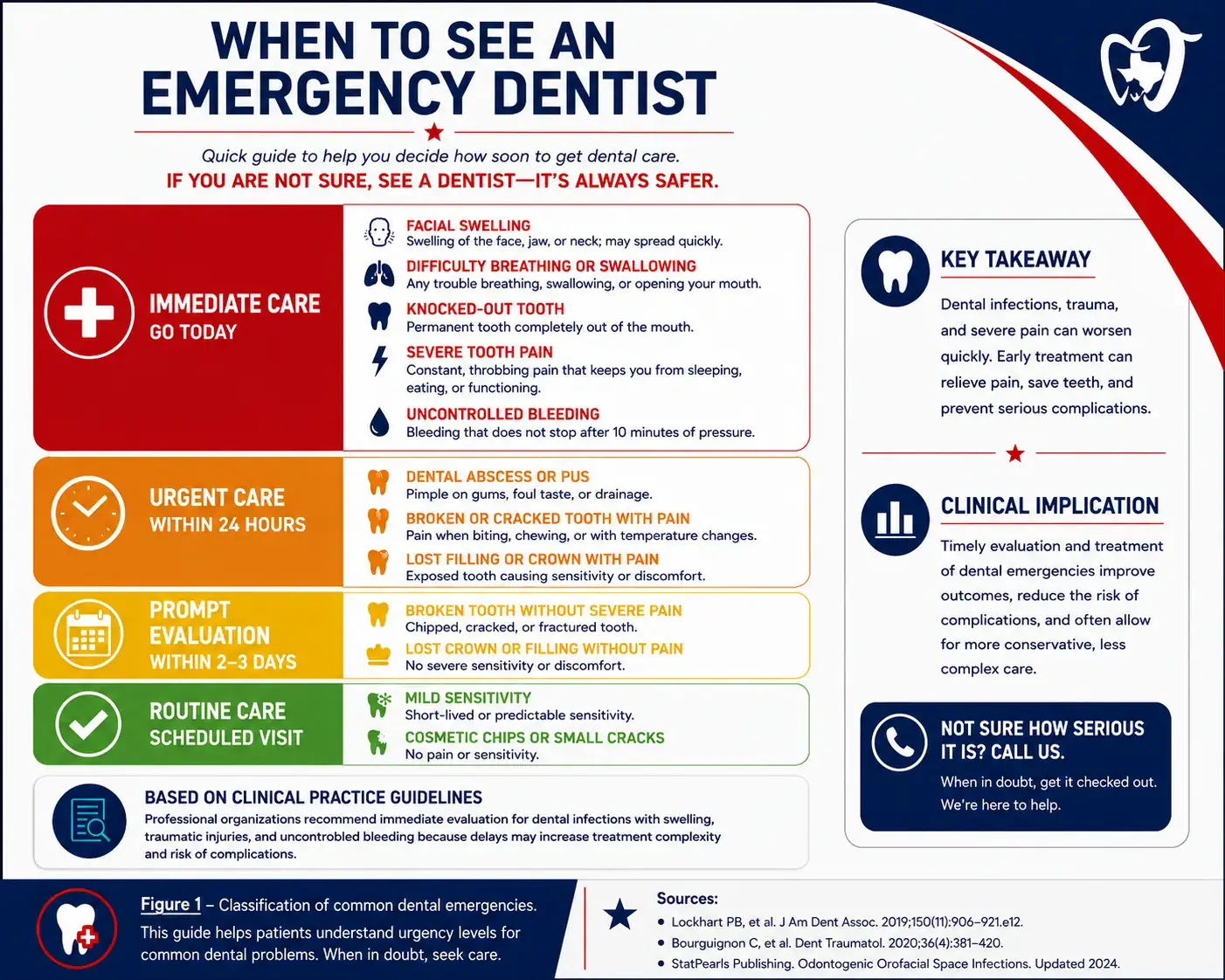
Not all dental problems require immediate treatment. However, certain conditions benefit from urgent evaluation because delays may increase the risk of complications.
Common dental emergencies
Common dental emergencies include severe toothache, dental abscesses and facial swelling, knocked-out teeth (avulsed teeth), broken or fractured teeth, dental trauma, uncontrolled bleeding, and lost crowns or restorations causing severe symptoms. According to emergency dentistry literature, dental infections and traumatic injuries represent the most time-sensitive situations.
Clinical takeaway
Dental emergencies involve conditions where prompt treatment can reduce complications, preserve teeth, or prevent infection spread.
Patient takeaway
If you have severe pain, swelling, trauma, or bleeding, seeking treatment quickly may help save your tooth and prevent bigger problems.
Tooth Pain: What the Research Shows
Severe tooth pain is one of the most common reasons patients seek emergency dental care. Research demonstrates that irreversible pulpitis (inflammation of the dental pulp) is often responsible for intense tooth pain.
Antibiotics versus definitive treatment
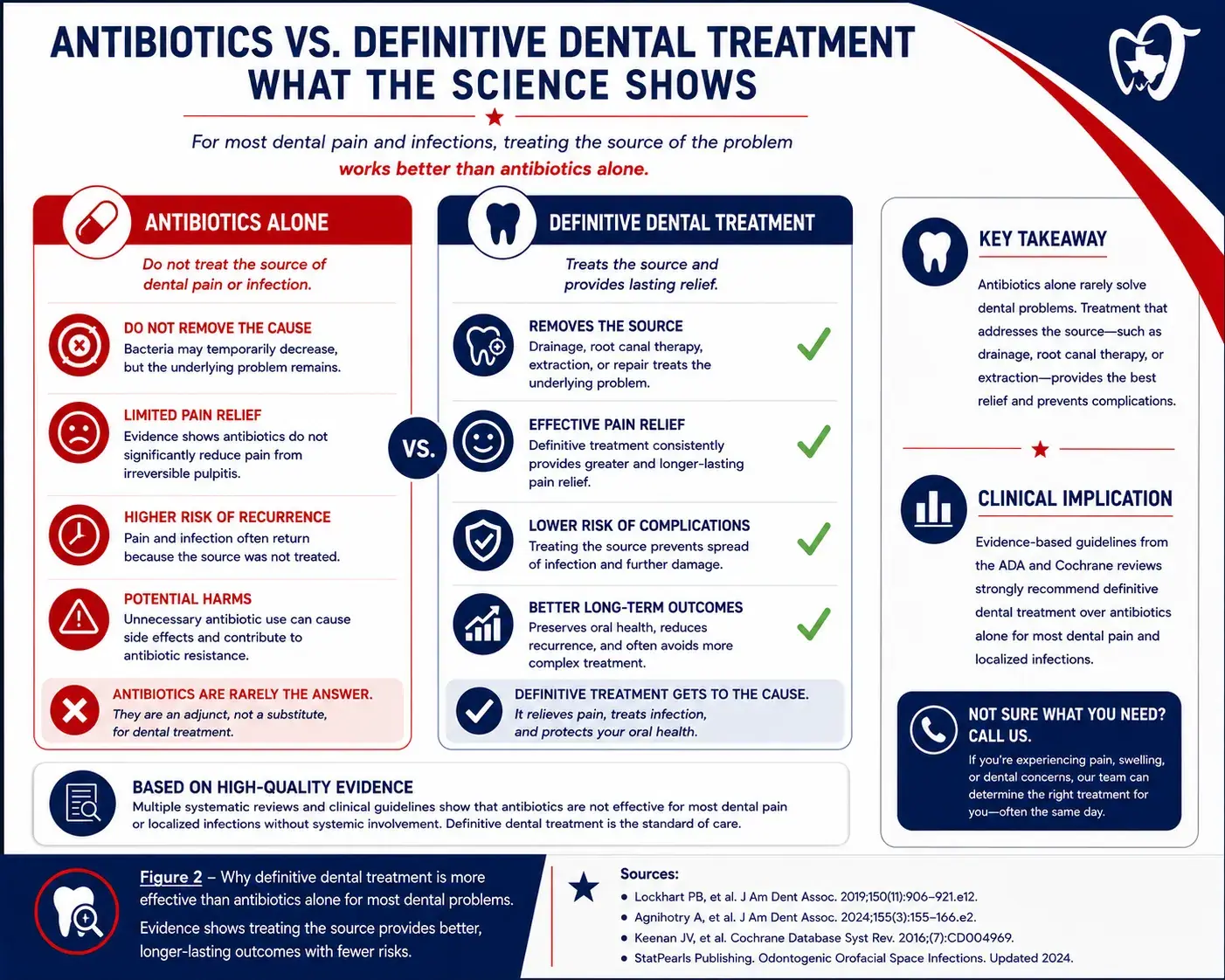
Studies show that antibiotics alone do not significantly reduce pain caused by irreversible pulpitis. Instead, definitive treatment such as root canal therapy, pulpotomy, or tooth extraction provides the greatest relief. This finding is important because many patients assume antibiotics will 'fix' a painful tooth. Scientific evidence shows that treatment of the source of the problem is usually required.
Clinical takeaway
Severe tooth pain usually requires definitive dental treatment rather than antibiotics alone.
Patient takeaway
Antibiotics often do not cure severe toothaches. The tooth usually needs treatment to remove the source of the pain.
Dental Infections and Abscesses: Why Prompt Treatment Matters
Dental abscesses occur when bacteria invade the pulp and surrounding tissues. Most localized infections can be treated successfully through drainage, root canal treatment, extraction, and appropriate supportive care.
Antibiotics as adjunct, not primary treatment
However, untreated infections may spread into facial spaces and, in rare cases, create serious medical complications. Scientific reviews and professional guidelines emphasize that antibiotics should not be viewed as a substitute for dental treatment.
Clinical takeaway
Dental infections require treatment of the source of infection. Antibiotics are often an adjunct—not the primary treatment.
Patient takeaway
An abscess will not usually go away on its own. Getting treatment early can prevent more serious problems.
Facial Swelling: When Emergency Care Becomes Urgent
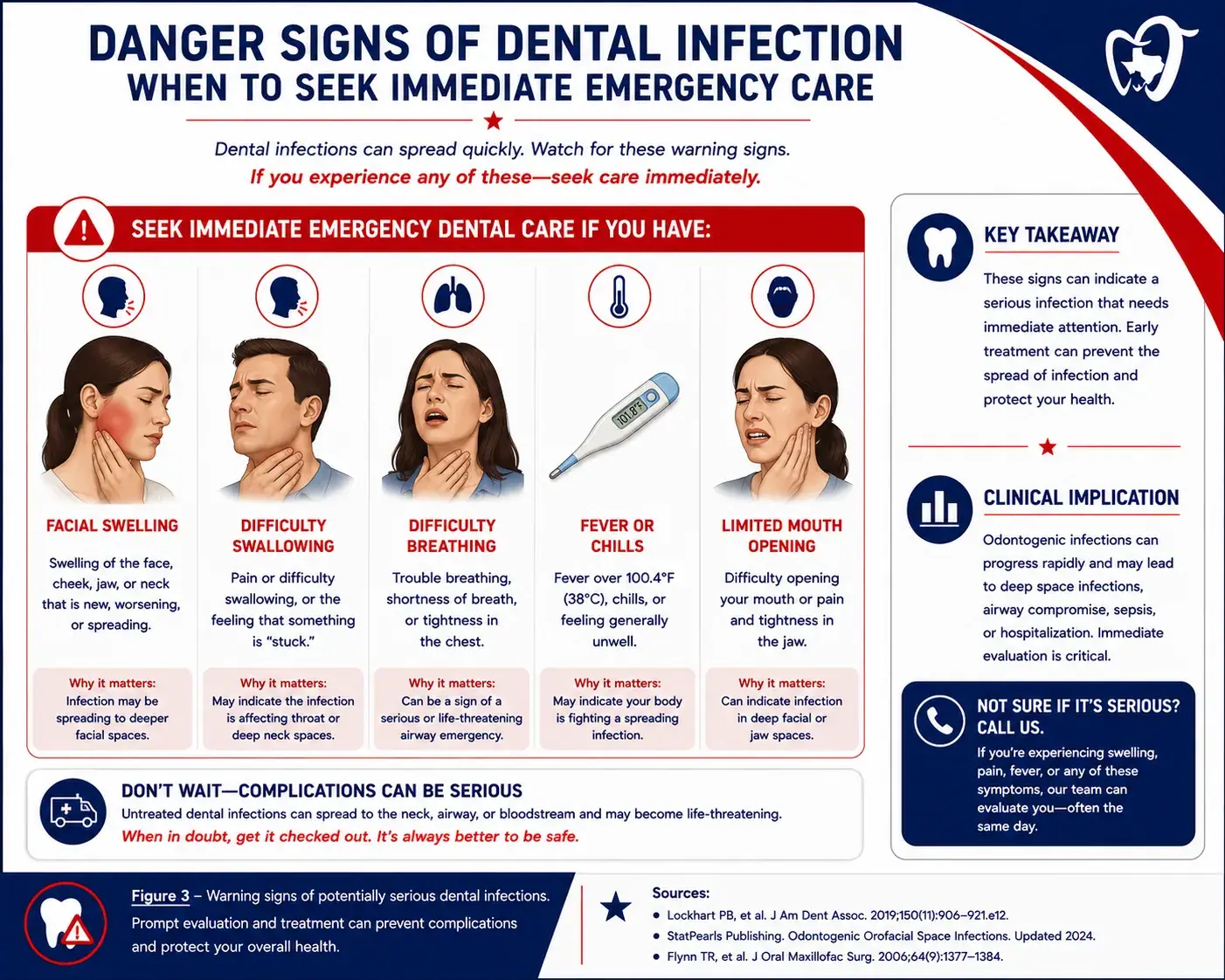
Facial swelling is one of the most important warning signs in dentistry. Patients experiencing rapidly increasing swelling, difficulty swallowing, difficulty breathing, fever, or limited ability to open the mouth require urgent evaluation.
Warning signs of serious infection
Research on odontogenic infections demonstrates that delays can increase the risk of deeper tissue involvement and hospitalization.
Clinical takeaway
Facial swelling associated with dental infection should be evaluated promptly.
Patient takeaway
If swelling spreads into the face, neck, or throat, do not wait. Seek care immediately.
Knocked-Out Teeth: Every Minute Matters
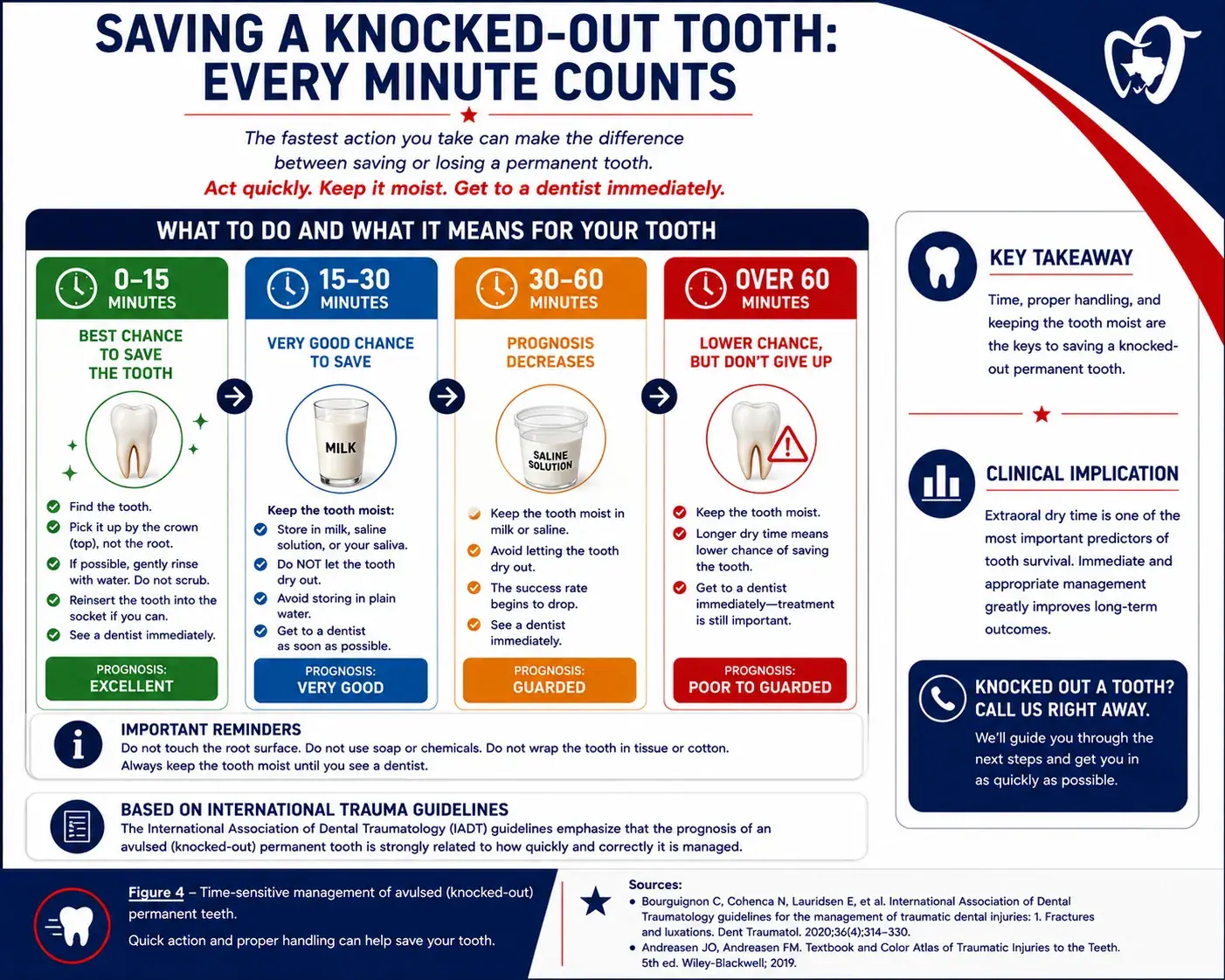
One of the most time-sensitive dental emergencies is complete tooth avulsion. The International Association of Dental Traumatology (IADT) reports that the survival of a knocked-out permanent tooth depends heavily on how quickly the tooth is repositioned.
Proper handling and timing
The highest success rates occur when the tooth is located immediately, the root surface is handled carefully, the tooth is kept moist, and reimplantation occurs as quickly as possible. Milk, saline, and specialized tooth-preservation solutions have all been recommended as temporary storage media.
Clinical takeaway
The prognosis of an avulsed tooth is strongly related to extraoral time.
Patient takeaway
If a permanent tooth is knocked out, every minute counts. Immediate dental care may save the tooth.
What Happens When Dental Problems Are Ignored?
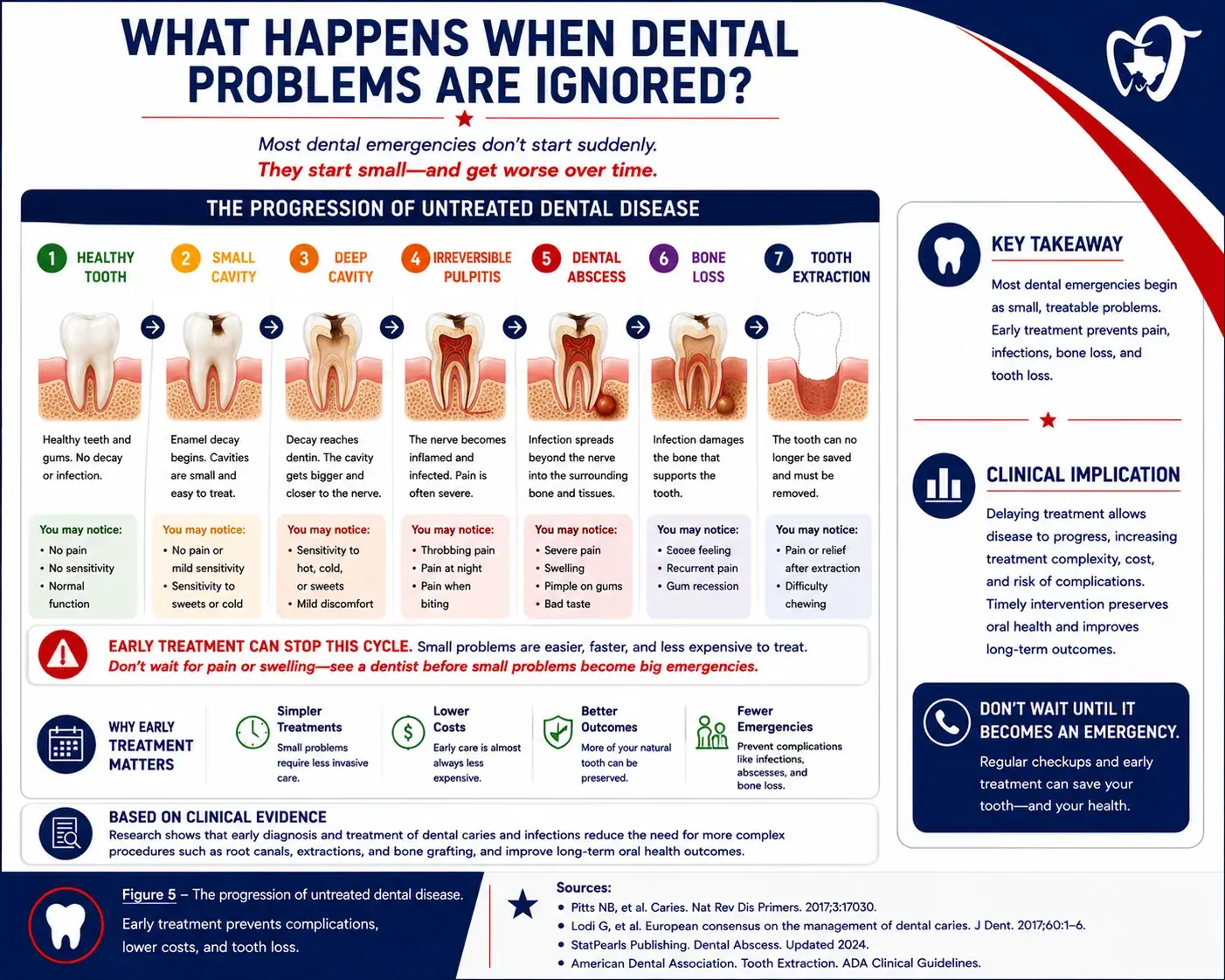
Many dental emergencies begin as small, treatable problems that worsen over time when treatment is delayed. A small cavity may eventually progress into severe decay, irreversible pulpitis, dental abscess, bone loss, or tooth extraction.
Early intervention benefits
Research consistently demonstrates that earlier treatment often results in simpler, less invasive, and less expensive care.
Clinical takeaway
Early intervention often reduces treatment complexity and preserves more natural tooth structure.
Patient takeaway
Getting treatment sooner often means easier treatment later.
Texas Dental Center: Clinical Perspective
In daily practice, many emergency patients present after several days or weeks of worsening symptoms. Frequently, conditions that could have been treated conservatively have progressed into more complex situations requiring root canal treatment, extraction, bone grafting, or surgical intervention.
Emergency dentistry is not simply about relieving pain—it is about identifying the underlying cause and preserving long-term oral health whenever possible. The goal of emergency treatment is to relieve discomfort, control infection, protect oral structures, and provide a clear path toward definitive care.
Summary: What Patients Should Know
- Severe tooth pain often requires definitive dental treatment.
- Antibiotics alone usually do not solve most dental emergencies.
- Dental abscesses should be treated promptly.
- Facial swelling can indicate a serious infection.
- Knocked-out teeth require immediate attention.
- Broken teeth should be evaluated as soon as possible.
- Modern evidence supports non-opioid pain management.
- Early treatment often reduces long-term complications.
Frequently Asked Questions
Is a toothache considered a dental emergency?
Can antibiotics cure a tooth infection?
How long can I wait with a dental abscess?
What should I do if my tooth gets knocked out?
Can emergency dentists perform extractions the same day?
References
- Lockhart PB, Tampi MP, Abt E, et al. Evidence-based clinical practice guideline on antibiotic use for the urgent management of pulpal- and periapical-related dental pain and intraoral swelling: A report from the American Dental Association. Journal of the American Dental Association. 2019;150(11):906-921.e12. PubMed (opens in a new tab)
- Carrasco-Labra A, Polk DE, Urquhart O, et al. Evidence-based clinical practice guideline for the pharmacologic management of acute dental pain in adolescents, adults, and older adults: A report from the American Dental Association Science and Research Institute, the University of Pittsburgh, and the University of Pennsylvania. Journal of the American Dental Association. 2024;155(2):102-117.e9. PubMed (opens in a new tab)
- Agnihotry A, Thompson W, Fedorowicz Z, van Zuuren EJ, Sprakel J. Antibiotic use for irreversible pulpitis. Cochrane Database of Systematic Reviews. 2019;5(5):CD004969. PubMed (opens in a new tab)
- Fouad AF, Abbott PV, Tsilingaridis G, et al. International Association of Dental Traumatology guidelines for the management of traumatic dental injuries: 2. Avulsion of permanent teeth. Dental Traumatology. 2020;36(4):331-342. PubMed (opens in a new tab)
- Hoerter JE, Malkin BD. Odontogenic Orofacial Space Infections. In: StatPearls [Internet]. Treasure Island (FL): StatPearls Publishing. 2023. PubMed (opens in a new tab)
- Flynn TR, Shanti RM, Levi MH, et al. Severe odontogenic infections, part 1: prospective report. Journal of Oral and Maxillofacial Surgery. 2006;64(7):1093-1103. PubMed (opens in a new tab)
- Feldman CA, Fredericks-Younger J, Desjardins PJ, et al. Nonopioid vs opioid analgesics after impacted third-molar extractions: The Opioid Analgesic Reduction Study randomized clinical trial. Journal of the American Dental Association. 2025;156(2):110-123.e9. PubMed (opens in a new tab)
Experiencing a dental emergency? Learn more about our emergency dentistry services and same-day care options.
